Intuit Agent Chat
Built and scaled the end-to-end agent chat stack that became Intuit's company-wide standard, serving tens of millions of users across TurboTax and QuickBooks.
Problem
Intuit Assist was the company's first use case with LLMs - answer support questions. But as foundation model capabilities quickly evolved, Q&A was no longer enough. The prize was in embedding agents seamlessly in existing workflows to take safe actions and be more meaningfully useful. Many product teams were independently building the same primitives (streaming, threads, document upload, rich rendering etc.) from scratch, which meant duplicative efforts and disjointed AI experiences across products.
Approach
Building a new platform and getting to company wide adoption without mandate required enterprise-SaaS-like model: build conviction to focus on one thing, prove success with a few lighthouse partners, and build for the future with hard-to-copy differentiation.
Drove focused conviction for pivot. Realizing every product team needed the same primitives, I pivoted the team's efforts from Intuit Assist to focus on the new Intuit Agent Chat platform.
- Brought product teams together from Turbotax, Quickbooks, Mailchimp, and our customer support & expert network teams, to identify the top shared patterns and use cases.
- Focused on building these core primitives for a flexible and scalable agent chat stack, bundling the UX and backend agent wiring infrastructure.
- Launched the MVP in 4 months before GED (Intuit's global company wide hackathon event) and immediately got over 40 teams experimenting on it.
- Ran a monthly launch cadence (instead of the previous quarterly cadence) to build momentum on showcasing new capabilities; grew a developer community of hundreds of developers; and continued to grow adoption.
Proved success with Lighthouse teams
- Partnered with QuickBooks BI team to deeply understand a focused segment's problems to solve with AI, built the agent conversation experience embedded in QuickBooks, launched to 200K customers.
- Partnered with TurboTax select agent teams to add shared capabilities such as dynamically extracting page context, take safe actions, and flexible mobile patterns.
- Built a reference demo at the CTO's Tech Tuesday earned a unanimous executive vote to standardize as the defacto platform for the company
Future-proofed with differentiation
- After achieving product market fit with the Intuit Agent Chat platform, observed insight from the industry that defensibility is not in chat but in the unique product context we can provide agent and deep integration in existing GUI workflows.
- Chat works for ambiguous exploration but GUI remains more effective for high-stakes workflows like tax filing or financial reconciliation. Users need the agent to actually see their work and take actions within it. This drove our investment in context-aware agents, headless composability, and the AI-to-human expert handoff.
What I built
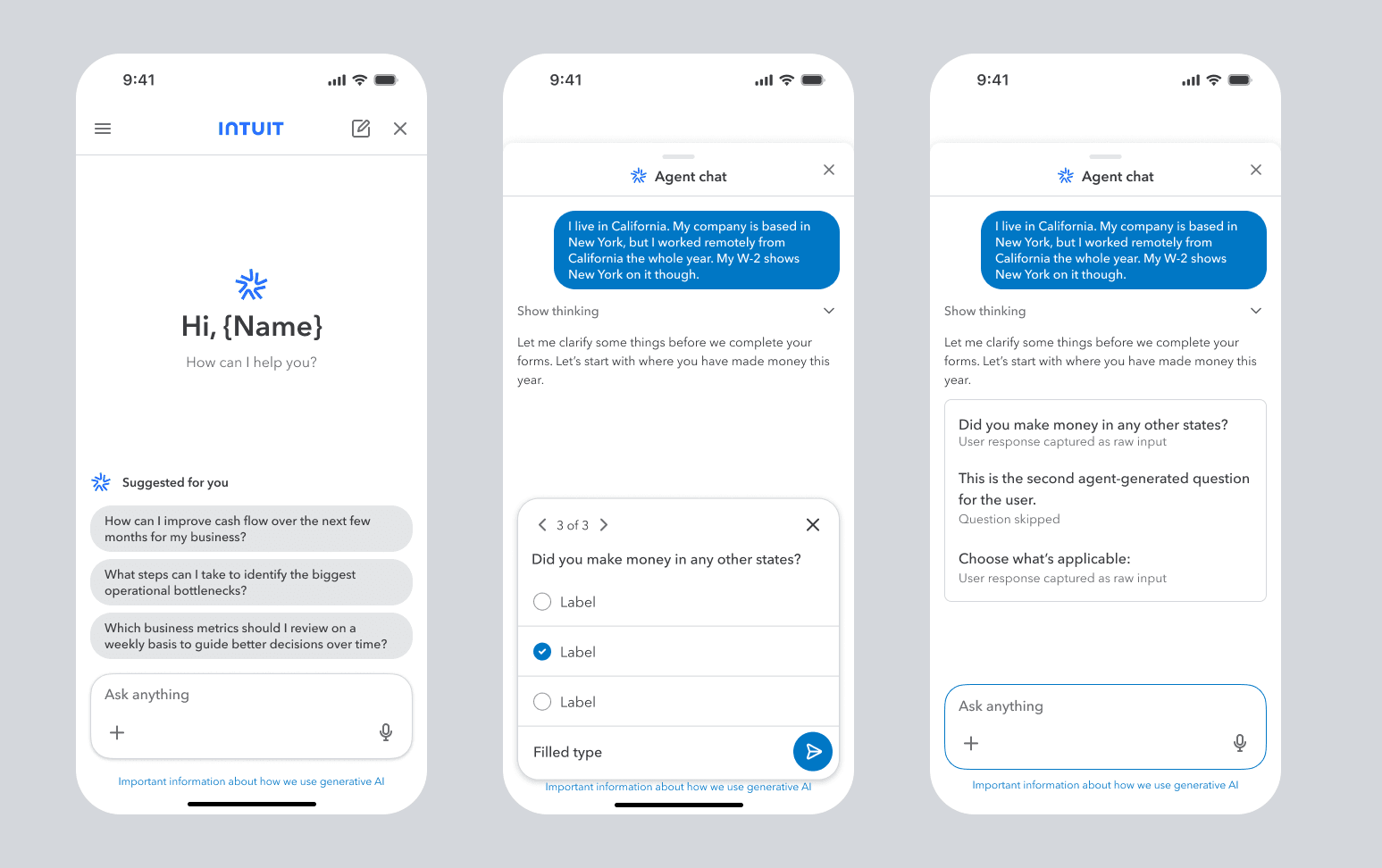
Built Intuit Agent Chat as a single cross-platform product (web, iOS, Android native) that teams can use to ship an agent experience in weeks instead of months.
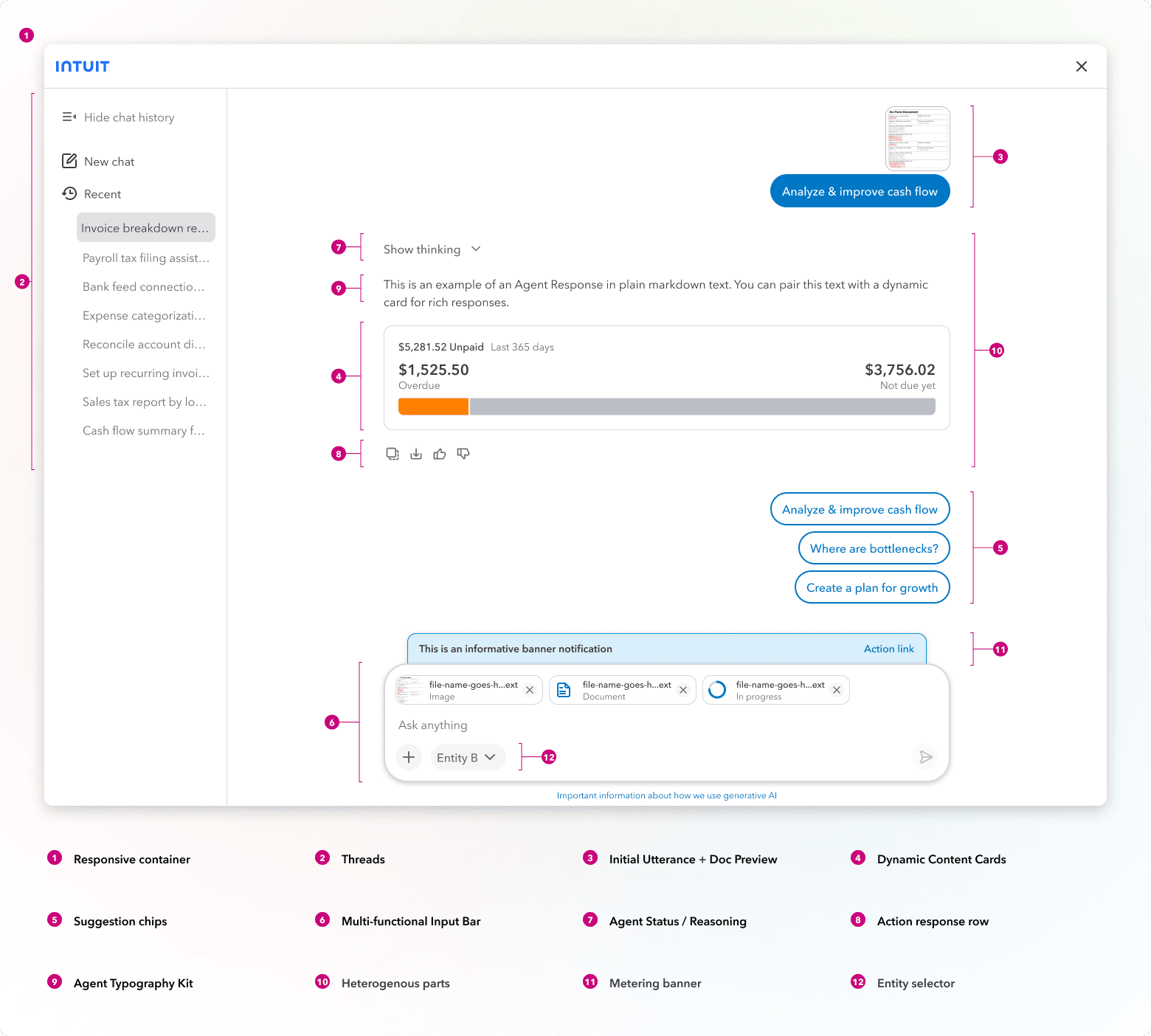
The platform brings:
Agent conversation UX kit
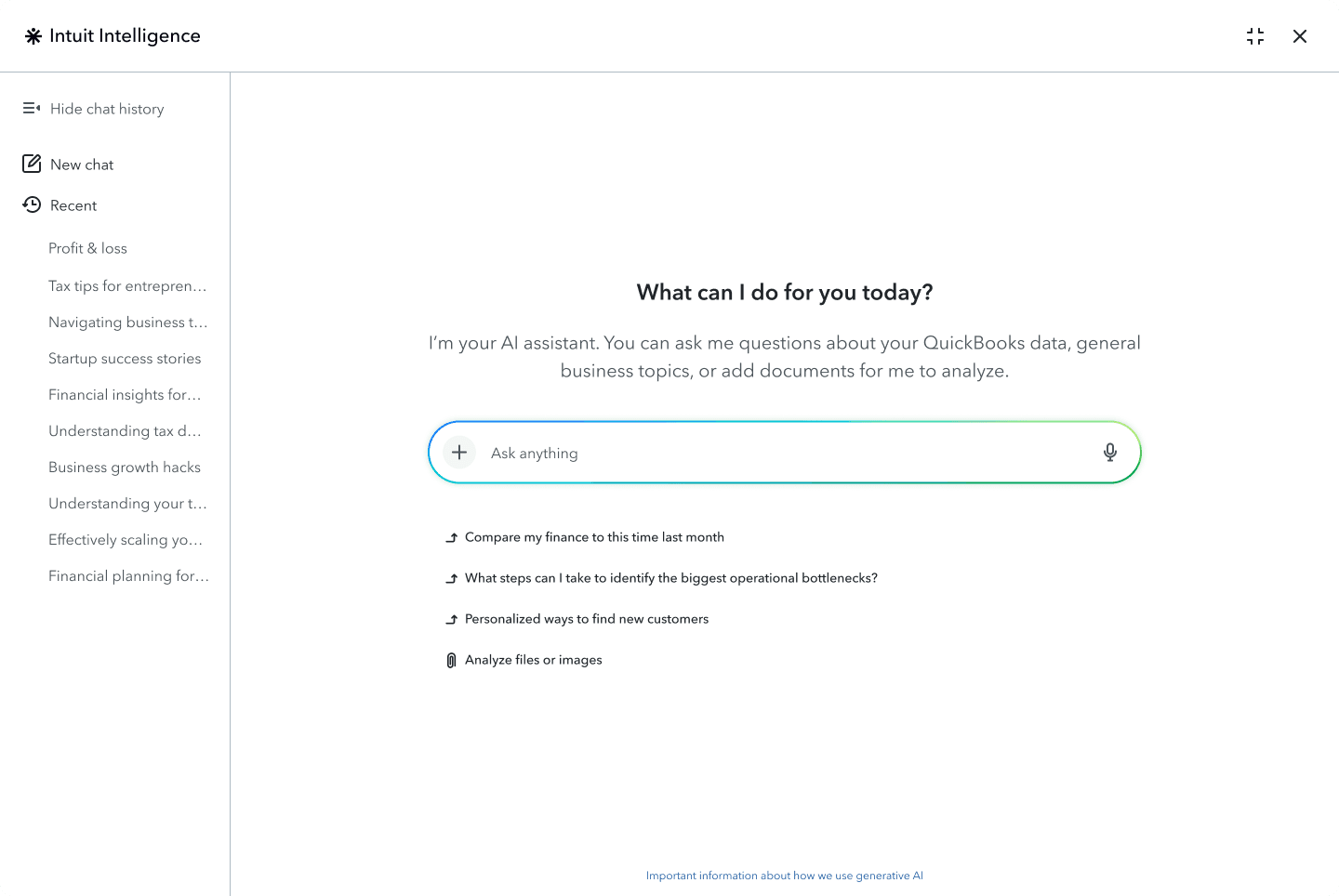
- Flexible chat surfaces (embedded panel, side panel, full screen) that theme across brands; threaded conversations that persist across sessions; dynamic welcome flows
- Human in the loop cards to gather structured input from user and get confirmation for safe actions
- The rendering system handles native markdown and dynamic cards, agent reasoning streams, citations, and follow-up suggestions, all extensible so domain teams can plug in custom renderers without forking the widget.
Conversation infrastructure. The backend contract for conversations, streaming responses, maintaining state across authenticated and pre-auth sessions.
Compliance and scale. PII redaction, configurable data retention, and tax-context safety (7216 compliance) built in
Expert handover. Agent to human expert handoff in the same conversation stack for seamless transfer experience and context handoff
Context orchestration. Give agents access to UX context and UX actions and coordinate them to get complex workflows done directly in product.
Impact
| 70+ agent experiences | in production across teams in TurboTax, Quickbooks, Mailchimp, and internal developer teams, across web and mobile |
| Tens of millions of daily users | tested for scale, supporting tax peaks at high scale |
| Company-wide standard | unanimous executive vote to standardize as defacto platform |
| ~10 months to PMF | from zero product-market fit to Intuit's default agent experience |
| Context orchestration | brought new platform primitive that gives agents context and queryable actions in our products; concept to funded cross-team mission in 30 days |
| AI+human handoff | built context handover primitives that close the last mile of solving customer's problems with experts, without asking them to repeat themselves |
| 600+ developer community | organic adoption channel that converted interest into committed migration |
Learnings
Chat is the minimum viable AI interface but not the differentiation. We started with the chat UI but that doesn't mean customers care about a chat UI. Customers want to get their job done better and faster and they don't like disruptions in workflows that they're already familiar with. The real differentiation to build for is to deeply embed the agent in existing workflows, as a collaborator across the product, not just as a chat.
Production gap is in the seams between UI and the model. It's easy to get lost in getting the perfect UX and getting the perfect evals, but much of the real needle moving work is in between: the agent communication protocol, conversation state across auth boundaries, compliance, human handoff, and the developer experience that makes everything as automated as possible. The companies that invest in this infrastructure early will compound their advantage as they scale to more surfaces and use cases, and avoid paying the fragmentation tax.
Product context is the agent's moat. LLMs and chat UI are commoditized. The compounding advantage will come from how well the agent understands product's state, how fluidly it acts within workflows, and how effectively you capture expert signal to improve it over time.